Total knee replacement has been one of the most successful operations in orthopedics for decades. But there is more than one way to perform a knee replacement, and one of the more interesting areas of change has been how we think about alignment.
For many years, the traditional goal was relatively straightforward: make the leg mechanically straight and place the implants in a predictable position.
That approach works very well and has a long track record.
More recently, though, surgeons have started asking a different question:
Should every knee be aligned to the same target, or should we try to reproduce more of the individual anatomy and balance of the knee that patient started with?
That has led to several different alignment strategies, including mechanical alignment, kinematic alignment, and functional alignment.
There are many ways to get an excellent result in total knee replacement. I do not think there is one alignment strategy that is right for every patient.
What is important is understanding the strategy being used and considering whether it makes sense for the individual knee.
Mechanical Alignment
Mechanical alignment has been the traditional approach to total knee replacement for many years.
The goal is to position the implants relative to the mechanical axes of the femur and tibia and create a reproducible, relatively neutral overall alignment.
In simple terms, the surgeon is trying to create a predictable mechanical construct.
There is a very good reason this became the standard approach: it works. Mechanical alignment has decades of experience behind it and has produced excellent outcomes for a tremendous number of patients.
The limitation is that not every person starts with the same anatomy.
Some people naturally have a little more varus, or bow-legged alignment. Others have more valgus. Joint-line orientation also varies from person to person.
So while mechanical alignment creates a consistent target, it does not necessarily recreate the anatomy that every patient had before developing arthritis.
That observation helped lead to kinematic alignment.
Kinematic Alignment
Kinematic alignment starts from a different place.
Instead of trying to make every knee mechanically neutral, the goal is to reproduce the patient’s native joint surfaces and joint orientation as closely as possible.
One important point is that kinematic alignment does not require a robot.
In fact, one of the classic ways to perform kinematic alignment is essentially a measured-resection technique.
The surgeon measures the amount of bone and cartilage being removed and attempts to replace that same thickness with the implant.
This can be done very accurately with conventional instruments and calipers.
It can also be done with navigation or robotic assistance.
That distinction is important:
Kinematic alignment is a strategy. Robotics is a tool.
They are not the same thing.
Functional Alignment
Functional alignment takes the concept of individualized alignment in a somewhat different direction.
Rather than relying only on predetermined bone cuts or trying to exactly reproduce the native joint surfaces, functional alignment also considers how the soft tissues around the knee behave.
During surgery, the surgeon can assess the spaces between the femur and tibia in flexion and extension and evaluate how those spaces change as tension is applied to the ligaments.
The implant position can then be adjusted to create a knee that is appropriately balanced throughout its range of motion while still staying within reasonable alignment boundaries.
This is one of the areas where navigation and robotic technology can be especially useful.
The technology allows the surgeon to quantify implant position, alignment, and soft-tissue balance very precisely and then make very small changes to the plan before making the final bone cuts.
But again, the robot is not deciding the alignment strategy.
A robotic system can be used to perform:
- Mechanical alignment
- Kinematic alignment
- Restricted kinematic alignment
- Functional alignment
The robot helps execute the plan.
It does not decide what the plan should be.
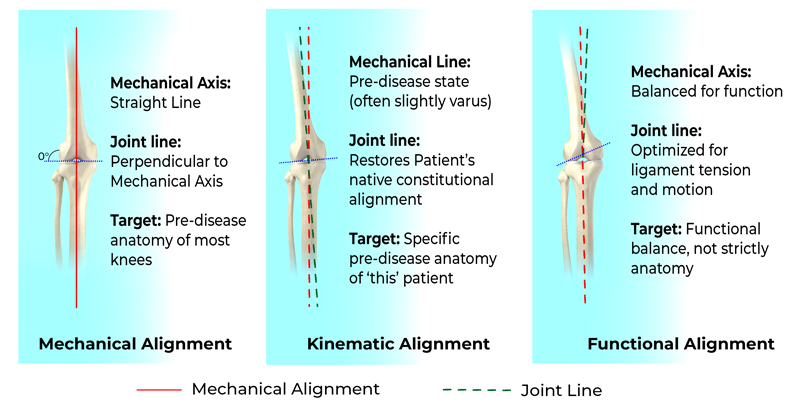 Different Alignment Strategies in Total Knee Replacement image
So What Is the Difference?
| Strategy | Basic Question | What Mainly Guides the Reconstruction? |
|---|---|---|
| Mechanical alignment | How do we create a predictable, mechanically neutral knee? | Mechanical axes and standardized alignment targets |
| Kinematic alignment | How do we reproduce this patient’s native joint surfaces? | Native anatomy and measured bone resections |
| Functional alignment | How do we position the implants so this particular knee is balanced and functions well? | Anatomy plus intraoperative soft-tissue tension and gap assessment |
There is also overlap between these strategies.
For example, restricted kinematic alignment attempts to reproduce the patient’s native anatomy but places boundaries around how far the final alignment is allowed to deviate from more traditional targets.
As technology has improved, the lines between these approaches have become somewhat less rigid.
There Is More Than One Way to Get an Excellent Result
This is probably the most important point.
There are many ways to perform an excellent total knee replacement.
Mechanical alignment is not outdated simply because newer alignment strategies exist.
Likewise, kinematic or functional alignment should not automatically be considered better simply because they are newer or more individualized.
What has changed is our ability to measure the knee much more precisely and to think more carefully about the individual patient in front of us.
For one patient, a very traditional mechanical alignment may make perfect sense.
For another, preserving more of the patient’s native anatomy may be desirable.
For another, soft-tissue laxity, deformity, previous injury, bone loss, or unusual native alignment may make a more individualized strategy useful.
That is why I think it is worth considering alignment as a strategy rather than simply a number on an X-ray.
The goal is not to decide which alignment philosophy wins.
The goal is to create a knee that is stable, durable, balanced, and as natural-feeling as possible for that individual patient.